Tuesday, March 27, 2012

Beaver Pond Journal September 26, 1999

"Drove on towards Indian Lake. Stopped at the beaver pond at the side of the road just east of Squaw Lake trailhead. The fall colors on the hillside across the pond and reflection on the pond were quite good. The level of the pond was up since the last time we were here. I got out my compass to check the location of the late afternoon sun. Looked as though this would be a great scene as the sun begins to drop in the western sky. Mary and I decided to be back at the pond about 2:30 P.M. I'd try photographing this landscape with the 4x5 camera, Mary with her 35mm gear.
About 2 P.M. we began the drive back to the beaver pond, arriving at 2:30 P.M. The light looked O.K. so I set up the 4x5 camera to take a look on the ground glass, not bad. Then I added a polarizing filter and an 81B warming filter......WOW! Mary worked with both her Minolta 600si and 7000 bodies and a few different lenses to shoot a number of images while I worked with the 4x5 taking three images."

4x5 Camera Set Up


 The Beaver Pond 35mm

Click on any image for a larger version

Thanks for visiting Bunch's Journal, more beaver pond journal entries are on the way.

You can visit my website for more photos at:

Bunch

Monday, March 12, 2012

An Adirondack Beaver Pond Journal

Deep in the heart of the ancient Adirondack Mountains lies an old beaver pond that beckons me to return, time and again. It is here that solitude, so rare these days, can be found.
As dusk settles over the mountains a whitetail deer silently appears at the shore of the pond to drink. Dead timber, skeletons of the trees they once were, are now standing like sentinels all across the pond. Wood ducks float quietly among these strange guardians.
Dusk deepens into night. A full moon rises above the treetops, its illumination discovering wakes on the still surface of the pond. Wakes left by beavers on patrol, inspecting the dam and preparing for a long nights work stocking the beaver lodge's pantry for the long winter ahead. Crickets are singing and a barred owl, up on the hillside overlooking the pond, cuts the dampening air with a series of hoots. Not wanting to be discovered by this avian predator a ruffed grouse hunkers down in a tangle of blackberry bushes. The moon slips behind a lonely, thick cloud that blots out the moonlight. The darkness deepens and where there were hundreds, now there are thousands of stars twinkling across the dark expanse.
A faint glow appears in the eastern sky, a new day is beginning. The beaver return to the lodge. A good nights work has been accomplished by nature's engineers and now it is time for some rest. The whitetail deer returns to the pond for a quick drink before heading off to its daytime bed.
The sun takes its turn to peek over the eastern treetops, the new day is here. The ruffed grouse leaves the protective berry patch, heading off in search of some succulent vegetation for breakfast. Soon a flock of cedar waxwings are busy plucking ripe blackberries from the pond-side berry patch that protected the grouse last night. A black bear intrudes on the cedar waxwings feast, scattering them to all points of the compass. Having eaten its fill the bear wanders off along the muddy shoreline of the pond leaving its tracks in the mud. The ripe blackberries signal the arrival of autumn at the beaver pond. The next feast for the pond's neighbors will occur with the ripening wild cherries and mast, beechnuts and acorns.
Long before autumn is officially over winter will arrive. At first with a dusting of snow on the landscape. The surface of the beaver pond turns to ice, locking the beaver in the lodge and under the surface of the pond. The beavers' work repairing the lodge will discourage a marauding coyote, bobcat or otter from digging into the lodge which now has a frost hardened mud coating that is as tough as concrete. The beaver will pass the winter safe and well fed under a heavy blanket of snow.
The black bear will solve the problem of surviving the long cold winter by hibernating, but only if it managed to obtain enough forage to provide sufficient fat reserves. Most of the ponds neighbors will struggle to see the return of spring, only the strongest will survive.
All is well at the pond. The cycle of life continues as it has for eons.

The Beaver Pond September 26, 1999


In 2006 the beaver that had occupied the pond, abandoned it. The trees and plants that are the beavers preferred food sources, especially aspen, had been exhausted from the larder that surrounded the pond. By late summer 2007 the pond was a mere puddle surrounded by a wide belt of soggy ground.
The change was dramatic and inspired me to begin photographing a series of yearly panoramas of the beaver pond. To obtain a photo of the entire pond required eight separate images "stitched" together to cover a 220° pan of the camera.
The original purpose for photographing the pond, after 2006, was to document the changes to the pond and surrounding area as it went through the process of succession. Now that a colony of beaver have taken up residence the focus of the project is changing from documenting  the succession of the pond to long term documentation and maintaining a photo-journal as well as a written journal of the changes at the beaver pond.


The Beaver Pond August 19, 2007

Click on any image for a larger version


Thanks for visiting Bunch's Journal, more beaver pond journal entries to follow,
Bunch
Click on the link below to visit my website
bunchlewisphotography.com

Wednesday, February 15, 2012

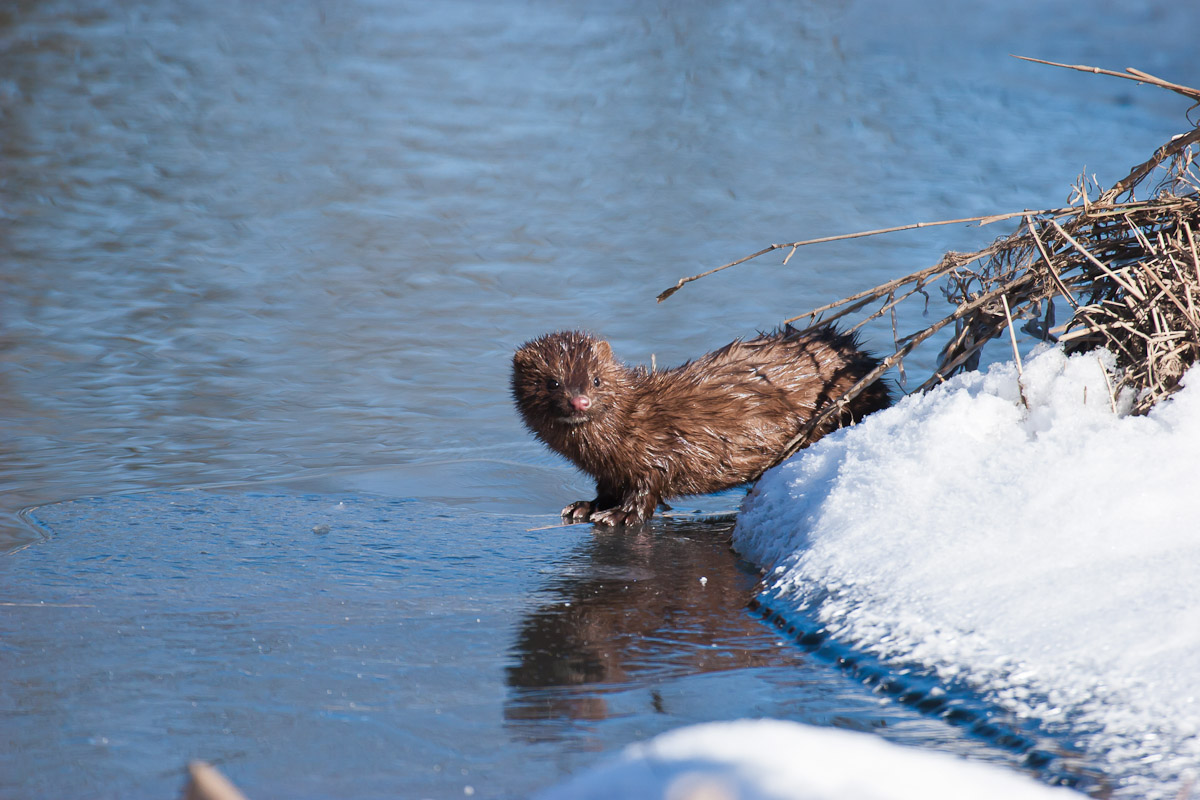
Mink Encounter

January 15, 2012 was a banner day! I left home to walk around the local lake and try for some muskrat photos. The sun was out and it was bright, the temperature was 12° with a strong wind. Arrived at my favorite shooting location and didn't have to wait long until a muskrat was swimming back to the bank den. Captured three good images of the muskrat with bright blue sky reflecting on the surface of the creek.
Three minutes later a mink appeared on the opposite shore, directly across from my location. It didn't seem to notice me while I shot image after image of the mink as it explored every nook and cranny. It worked its way downstream about one hundred twenty feet continually poking around, then to my amazement it dove into the creek. The mink swam to my side, me photographing it all the way.


A mink searching for a meal 

The mink continued to investigate every hole and crevice as it headed towards me. I wasn't able to see much of the mink, just a quick glimpse of part of its body, allowing me to track its progress. When the mink reached the muskrat feeding house its progress halted on a shelf of ice at water level, behind the hummock. There was a great deal of activity behind that hummock. From the movements that I could see, I think the mink was eating something, a fish I'd guess, but I was never able to see what it had caught. 
What happened next made my day! The mink peered over the top of the hummock, looking directly at me. I shot eleven images with just its head showing. It disappeared, then reappeared on top of the hummock giving me eleven more great shots. The mink disappeared again only to reappear once more, this time on the ice from behind the hummock. It was very curious about me and was only thirty five feet away. I captured eight more great images before the the mink went on its way, traveling downstream and out of sight. 


Mink checking me out

  The mink on the hummock


 Satisfying its curiosity before moving on

Click on any image for a larger version


You can see more mink photos on my website:

Thanks for visiting,
Bunch

Wednesday, January 18, 2012

Muskrats

On November 10, 2011 I was taking my regular early morning walk around the local lake. As I passed by the creek that flows out of the lake, I noticed an animal swimming upstream. The wake and sculling tail motion gave away the identification of the animal as a muskrat. I stopped to observed the muskrat for a few minutes before  continuing on my way.
As I walked the remainder of my morning loop, I was thinking that I didn't have any really good muskrat images in my wildlife catalog. When I got to work my mind kept wandering back to that swimming muskrat. How I could obtain some really good portraits and behavior images of these fascinating creatures?
I decided the first step would be to observe their daily activities from afar, so as not to disturb their natural behavior. For the next 16 days I stopped along my daily morning walk to observe the muskrats, adding considerably to my muskrat knowledge base. I supplemented my observations with research concerning muskrat biology.
By November 26th I was armed with lots of muskrat information and ready to try for some photos. Muskrats have many predators, mainly minks and raccoons, making them nervous and at times furtive.   


I knew in order to get within reasonable shooting range I would have to blend in and make any movement in slow motion to get a photo like the one above. In fact the that photo was taken the day of my first try and was successful because of the knowledge I had obtained beforehand.

Below are six more images of the over five hundred I've taken this past month and a half.


After awhile the the muskrats seemed to accept my presence and generally went about their daily routine, allowing me to capture many great images.

Click on any image for a larger version

You can view more of the muskrat images on my website:
www.bunchlewisphotography.com

Thanks for visiting my journal,
Bunch

Tuesday, January 3, 2012

Small Mammal Photography

Most small mammals; mice,voles lemmings,jumping mice and shrews, are generally nocturnal. To photograph them they must be confined in some sort of "studio". The studio or enclosure could be a fish tank or a similar object. I built mine using Plexiglas made for the picture framing industry. The advantage of using this grade of Plexiglas is that it is clearer than the standard grade. If you decide to build your own be advised that assembling the tank requires a special glue that works with Plexiglas. The glue is generally available from paint, glass and hardware stores. The studio, or mouse tank as I call it, can be any size you want. The dimensions of mine are 8" wide x 16" long X 6" high. I would however recommend a height of 10". The first deer mice I captured were easily able to jump out of the tank before I could get the cover in place. My cover is made from the same Plexiglas as the rest of the mouse tank.

MOUSE TANK & VICTOR TIN CAT MOUSE LIVE TRAP

To obtain small mammal models you will need to live trap them. I have found that the Victor Tin Cat Mouse Live Trap is a perfect piece of equipment for the job. I spray painted mine with camouflage paint to make it less obtrusive when it is located in public areas.

A MORE DETAILED VIEW OF THE TRAP

Next you will need to research both the required habitat and food sources for the targeted species. The trap should be placed in the proper habitat and baited with a suitable food source. The trap should be secured to a log or tree trunk with a length of stout wire to keep larger predators from running off with an occupied trap, although it isn't likely. The first time I put out my trap I found muddy weasel tracks all over the top of the trap the next morning. I've wired my trap to a solid object ever since. Further camouflage the the trap with leaves and pieces of bark.

I put my trap out late in the day and check it early the next morning. I pick up the trap even if it is empty, then put it out again in the early evening so as not to confine the small mammal for too long a period. Once you have a "model" in your trap, cover the floor of the mouse tank with materials from the surrounding area. You may also want to include some preferred food sources for the model to eat. Transfer the small mammal to the tank as gently and quickly as possible and get the cover in place. I open the cover of the trap slowly over and very close to the top of the mouse tank. This method will force the small mammal to jump into the tank, then quickly get the cover in place. The mouse tank should be placed on the ground with similar ground cover as was placed on the bottom of the tank, as a backdrop.

Now for the final step, the photography. Before photographing allow some time for them to settle down. Flash will typically be required to stop the motion of these fast moving small mammals. I have the flash positioned off camera and a diffuser on the flash head. I tried using a 100mm macro lens but quickly discovered the field of view was too narrow when keeping the front element close to the side of the tank to prevent reflections from showing. After trying a few different combinations I found my 24-70mm lens coupled to a 12mm extension tube to be a just right. This combination allows me to zoom in and out to frame the composition I want while keeping the front element close to the side of the mouse tank. Setting the camera's exposure mode to manual while keeping the flash in auto mode, you can set the aperture for the desired depth of field while adjusting the shutter speed for the desired ambient light. Since most small mammals are typically crepuscular or nocturnal a slightly darkened background is appropriate.

A DEER MOUSE


Sunday, April 11, 2010

Navy Photos


I've just included a new gallery on my website that is somewhat off track from the theme of my website but might be interesting nonetheless. The gallery consists of photos taken by me while serving in the US Navy in the mid to late 1960's. The content is informative with respect to the conditions that were prevalent around the world at that time. The ports of call were Japan, Okinawa, Vietnam, Taiwan, Hong Kong, The Philippine Islands, Singapore, Ethiopia, Egypt and the Suez Canal, Crete, Malta, Italy, Palma de Mallorca, Gibralter, Azore Islands, Peurto Rico, Guantanamo Bay, Cuba and Panama.
You can navigate to the my website page using this link:
http://bunchlewisphotography.com/site/#/page/navy-photos/

Bunch

Sunday, March 21, 2010

Winter & Eagles

Winter didn't cooperate at all this year. A scant amount of snow and most of that was iced over due to snow changing to rain. The conditions for tracking were poor at best. In spite of this I did manage to track a fisher, some weasels, a fox and a number of coyotes. Also found a coyote bed that had been used for many hours based on the amount of snow that had compacted and melted. I was also able to determine that the coyote was a female due to the manner in which it had urinated. An otter den that I had been observing for the third year in a row, had many comings and goings throughout the winter but as in the past two winters no sightings of  the inhabitant. Although otters may be out and about any time of day or night I believe this otter's activities were confined to nighttime, probably due to the proximity to civilization.

On February 21st I observed six bald eagles feeding on a coyote killed whitetail deer carcass out on the ice of the Sacandaga River near Northville in New York's Adirondack Mountains. There were never more than two eagles on the carcass at any one time. Ravens and crows were lurking about harassing the large birds of prey while trying to steal a morsel. Watched and photographed the eagles for twenty minutes.


A raven comes in for a closer look.
 
Spring is here, now it's time to watch for the return of the migrating birds and hibernating mammals coming out of a long winter's sleep. I've already discovered a remodeled woodchuck burrow and signs of skunks out and about.
 
Bunch